Before you try anything: always speak to a professional before cleaning, treating or applying any product to your stone. Every slab is different, and the wrong product can cause permanent damage. Contact us or a qualified stone restorer first.
Quick answer
Clean unprotected marble, travertine and limestone with warm water and a pH-neutral stone cleaner, using a soft cloth, and dry the surface afterwards. Avoid vinegar, lemon, most bathroom and multi-purpose sprays, bleach and abrasive creams, which etch, dull or scratch calcite stone. Once stone is protected with our film, ordinary non-abrasive household cleaners are fine.
Key points
- pH-neutral means neither acidic nor strongly alkaline.
- Many "natural" cleaners contain vinegar or citric acid.
- Dry the surface after cleaning to avoid water marks.
- Filmed stone can be cleaned with normal non-abrasive products.
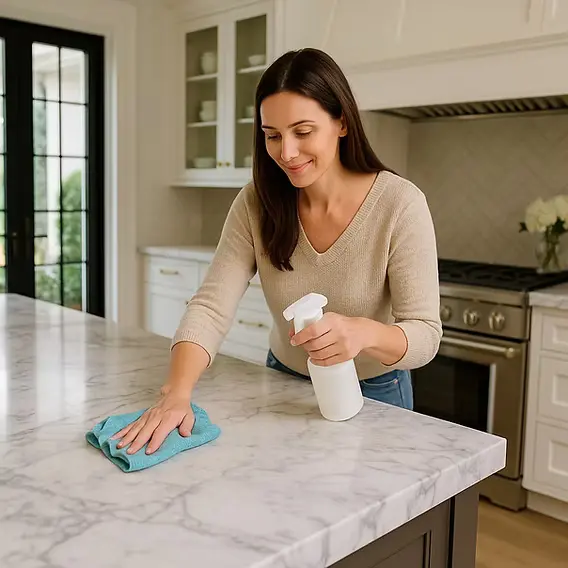
The daily routine for unprotected stone
- Wipe up spills straight away, blotting rather than smearing.
- Wipe the surface with warm water and a few drops of pH-neutral stone cleaner (or a mild, pH-neutral dish liquid).
- Use a soft microfibre cloth. Never scourers.
- Dry with a clean cloth to prevent water spots, especially on dark polished stone.
Products that damage stone
| Product | Marble, travertine, limestone, onyx | Granite, quartzite | Why |
|---|---|---|---|
| Vinegar, lemon, citric cleaners | Avoid | Usually OK | Acids etch calcite instantly. |
| Bathroom and descaling sprays | Avoid | Check label | Often acidic to dissolve limescale. |
| Multi-purpose sprays | Check label | Usually OK | Some contain acids or harsh solvents. |
| Bleach | Avoid | Occasional use | Can dull polish and damage sealers. |
| Abrasive creams and powders | Avoid | Avoid on polished | Scratch and dull the finish. |
| Oven cleaner, strong degreasers | Avoid | Avoid | Strongly alkaline; can damage stone and resins. |
Stone by stone
- Marble: pH-neutral only. The most common cause of dull patches near the sink is a daily vinegar or bathroom spray.
- Travertine: as marble, plus keep crumbs and grit out of the filled pores with a soft brush.
- Limestone: as marble, and dry spills fast because it absorbs water quickly.
- Quartzite and granite: more tolerant, but avoid harsh chemicals that can damage factory resin treatments.
- Engineered stone: avoid strong alkalis, solvents and oven cleaners, which affect the resin.
Cleaning once your stone is filmed
With our Stone Protection Film in place, you are cleaning the film, not the stone. Normal non-abrasive household cleaners are fine, including the sprays you would never use on bare marble. Still avoid scourers and abrasive creams, and use a chopping board for knives and trivets for hot pots. That is it. See the FAQ for more.
Frequently asked questions
Get a free, no-obligation quote
Request a free quote online or by email. We will call to arrange an on-site visit or a quote over the phone.