Before you try anything: always speak to a professional before cleaning, treating or applying any product to your stone. Every slab is different, and the wrong product can cause permanent damage. Contact us or a qualified stone restorer first.
Quick answer
Most stains in marble, travertine and limestone are removed with a poultice: an absorbent paste mixed with the right chemical, spread over the stain, covered and left for 24 to 48 hours so it pulls the stain out as it dries. Use hydrogen peroxide for coffee, tea and wine; a solvent such as acetone for oil; and a dedicated rust poultice for rust. If a dull mark remains after the colour has gone, that part is an etch and needs polishing, not more poulticing.
Key points
- First decide: is it a stain (darker, soaked in) or an etch (dull, lighter)?
- Match the chemical to the stain: peroxide for organic, solvent for oil.
- Always test in a hidden spot and wear gloves.
- Never use vinegar, lemon or acidic cleaners on calcite stone.
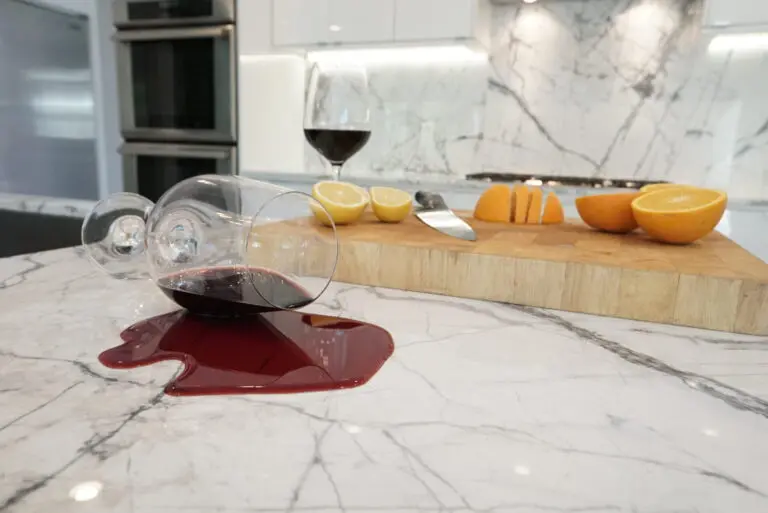
Step 1: is it a stain or an etch?
A stain is colour that has soaked into the stone. It is usually darker than the surrounding stone (or a colour, like the yellow of turmeric) and the surface still feels smooth and looks as shiny as the rest. An etch is damage to the surface itself: it looks dull, cloudy or lighter, and you may feel a slight roughness. Coffee and wine often do both, leaving a brown ring with a dull ring inside it.
Poultices only remove stains. For etches, see how to fix etch marks on marble.
Step 2: pick the right poultice
| Stain | Type | Poultice chemical | Notes |
|---|---|---|---|
| Coffee, tea | Organic (tannin) | Hydrogen peroxide | Common on travertine tables. Often leaves an etch too. |
| Red wine, berries | Organic | Hydrogen peroxide | Act fast. Wine is also acidic, so check for etching. |
| Cooking oil, butter | Oil | Acetone or mineral turps | May need two or three rounds on limestone. |
| Turmeric, curry | Organic dye | Hydrogen peroxide | Sunlight can also fade it over a few days. |
| Make-up, hair oil | Oil | Acetone | Common on vanities. |
| Rust | Metal | Rust poultice made for marble | Never use acidic rust removers on calcite stone. |
| Water rings | Water or minerals | Usually none | Dark water marks often dry out in a day or two. |
For light-coloured marble and travertine, pharmacy 3% hydrogen peroxide works on fresh stains; older or deeper tannin stains respond better to 12% hydrogen peroxide from a hairdressing or pool supplier. Higher strengths can lighten dark stones, so be cautious on black or brown marble and always test first.
Step 3: make and apply the poultice
- Mix the paste. Combine an absorbent powder (plain flour, talc, diatomaceous earth or whiting) with your chemical until it has the consistency of peanut butter.
- Spread it. Apply about 5 to 6 mm thick, extending a centimetre past the edge of the stain.
- Cover it. Lay plastic wrap over the top, tape the edges and poke a few small holes so it dries slowly.
- Wait. Leave it 24 to 48 hours until completely dry. The drying is what pulls the stain up into the powder.
- Remove and rinse. Lift the dry poultice with a plastic scraper, rinse with water and dry the stone. Repeat if the stain has lightened but not gone.
Wear gloves, ventilate the room when using solvents, and keep peroxide away from metal fittings and clothing.
Removing a coffee stain from travertine
Travertine coffee tables are the single most common stain question we hear. The brown ring is tannin that has soaked into the pores and fills. Apply a hydrogen peroxide poultice as above and check after 24 hours. If the brown is gone but a pale, dull circle remains, that is an etch from the coffee's acidity. On honed travertine a restorer can re-hone the area; on polished travertine it needs re-polishing. More on the stone itself on our travertine protection page.
What not to use
- Vinegar, lemon or "natural" acidic cleaners. They etch marble, travertine and limestone instantly.
- Bleach. It rarely helps with organic stains in stone and can damage some surfaces.
- Abrasive creams and scourers. They scratch polished stone.
- Heat guns or scrubbing. These can spread oil deeper or damage the surface.
Stopping stains for good
A sealer slows how fast a spill soaks in, but it does not stop stains forever and does nothing about etching. Our Stone Protection Film is a physical layer over the stone: coffee, wine and oil sit on top and wipe away, and the stone underneath is untouched. The usual order is to remove existing stains (or have the surface restored), then film it. See sealer vs protection film.
Frequently asked questions
Get a free, no-obligation quote
Request a free quote online or by email. We will call to arrange an on-site visit or a quote over the phone.