Before you try anything: always speak to a professional before cleaning, treating or applying any product to your stone. Every slab is different, and the wrong product can cause permanent damage. Contact us or a qualified stone restorer first.
Quick answer
True quartzite rarely etches, but it can be porous enough to absorb oil and dark liquids, and slabs sold as quartzite are sometimes marble or dolomite that do etch. Protection film covers both risks: nothing soaks in, nothing etches, and factory resin treatments on the surface are shielded from wear.
Key points
- True quartzite is recrystallised sandstone, harder than glass.
- Porosity varies a lot; some quartzites stain easily.
- "Soft quartzites" often contain calcite and can etch.
- Film protects either way, so you do not need to be certain.
What quartzite really is
Quartzite starts as sandstone. Heat and pressure fuse the quartz grains together into a dense, glassy rock that is harder than glass and does not react with kitchen acids. That is why it became the go-to natural stone for people who love marble but not etching, and why demand rose further after Australia banned engineered stone.
In practice the trade name "quartzite" covers a range of stones. Some are true quartzite. Some are quartzite with pockets of other minerals. And some are dolomites or marbles marketed as quartzite because the name sells. Super White is the best-known example.
Two quick tests
The glass test: true quartzite will scratch a glass tile; marble and dolomite will not. The lemon test: leave a drop of lemon juice on an offcut for five minutes, wipe it and look at an angle. A dull mark means the stone etches. We are happy to assess your stone on site and tell you what you are dealing with.
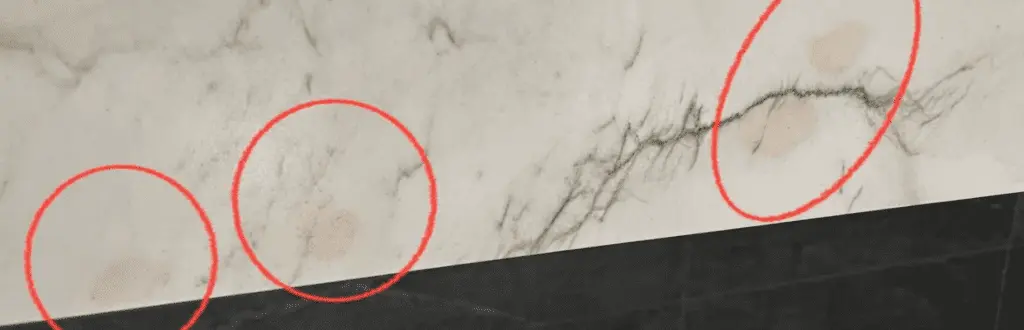
Even when a quartzite passes both tests, staining can still be an issue. The image below shows a quartzite benchtop marked by liquid that soaked into porous areas.