Before you try anything: always speak to a professional before cleaning, treating or applying any product to your stone. Every slab is different, and the wrong product can cause permanent damage. Contact us or a qualified stone restorer first.
Quick answer
Travertine is a form of limestone, so coffee, wine, citrus and vinegar etch it and its open pores absorb stains. Coffee often leaves a double mark: a brown tannin stain plus a pale etch. Clear protection film over the top stops both, and keeps the filled holes from wearing open. Matte/Satin film keeps the honed look most travertine has.
Key points
- Travertine forms at mineral springs and is full of natural holes.
- Coffee is acidic and tannic, so it can etch and stain at once.
- Filled pores can loosen and open up with wear.
- Film covers stone and fills, and keeps the honed texture.
What travertine is
Travertine is a limestone deposited by mineral-rich spring water, the same process that builds terraces at hot springs. As the calcium carbonate builds up, gas and water leave cavities behind, which is where travertine's characteristic holes come from. For benchtops and tables, those holes are filled with resin or cement and the surface is honed smooth.
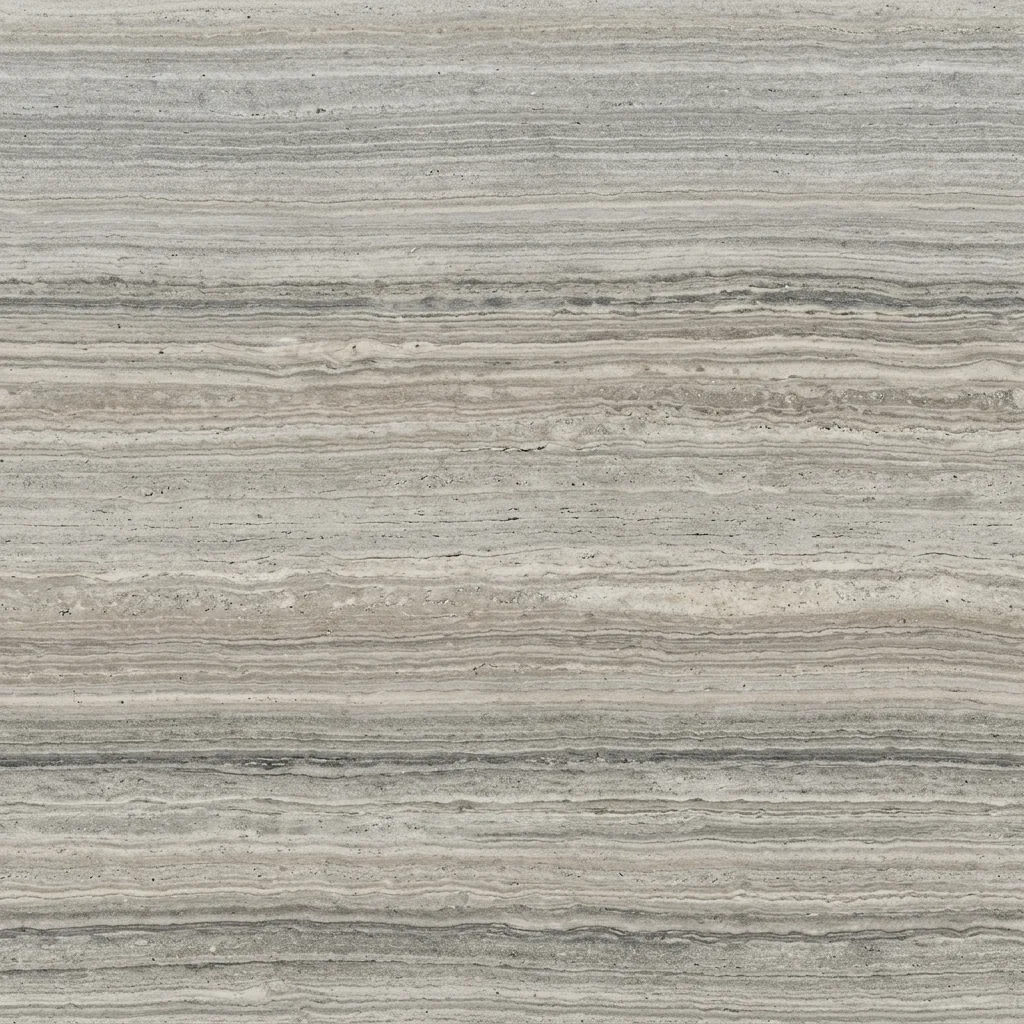
It comes in ivory, beige, walnut, red and silver tones, and can be cut two ways: vein cut, which shows linear bands (like the silver travertine pictured), and cross cut, which shows a cloudy, flowery pattern. Roman travertine from Tivoli is the historic benchmark; much of what is sold in Australia today comes from Turkey and Iran.
The travertine coffee table problem
Travertine tables are where we see the most damage, because they are used for exactly what etches them: coffee, tea, wine and fruit. A coffee cup leaves a brown ring as the tannins soak into the pores, and the acid in the coffee dulls the surface under it. A glass of wine does the same. Coasters help, but in real life, rings happen.
Film makes a travertine table genuinely usable. Drinks sit on the film, the pores and fills are sealed off under it, and the surface can be wiped with normal cleaners.