Before you try anything: always speak to a professional before cleaning, treating or applying any product to your stone. Every slab is different, and the wrong product can cause permanent damage. Contact us or a qualified stone restorer first.
Quick answer
Light etches on polished marble can sometimes be buffed out with a marble polishing powder, but most etching is best fixed by a professional stone restorer, who hones the damaged area with fine diamond abrasives and re-polishes it to match. Honed marble is re-honed rather than polished. Once repaired, a protection film stops acids reaching the stone so the etching does not return.
Key points
- Etching is surface damage; cleaning will never remove it.
- Light etches on polished marble: polishing powder may work.
- Deeper etches, or large areas: professional honing and polishing.
- Protection film after repair is how you avoid paying twice.
Check it really is an etch
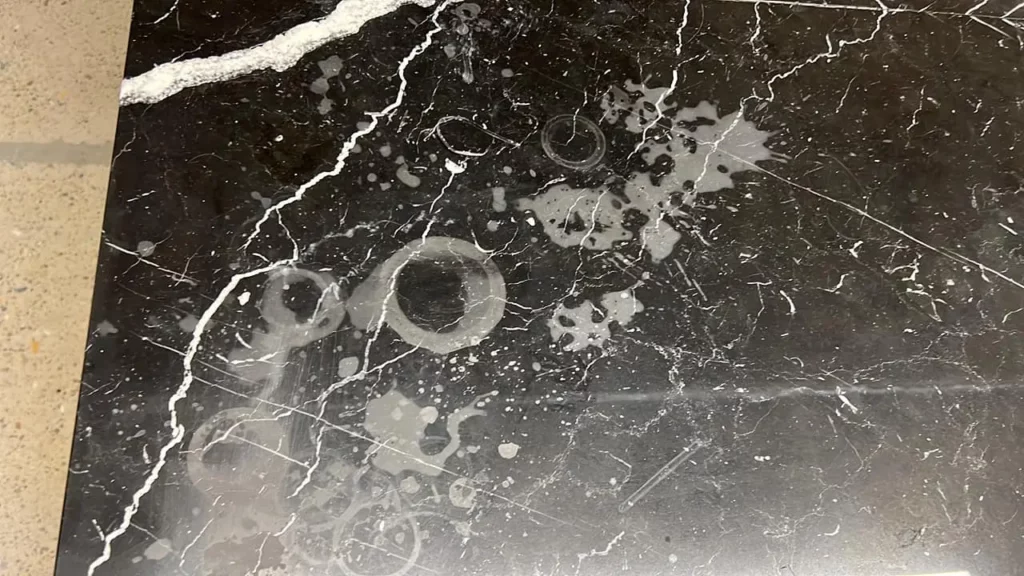
Look at the mark at a low angle to the light. An etch looks dull, hazy or lighter than the stone around it and may feel very slightly rough. It usually has the shape of whatever caused it: a glass ring, a lemon wedge, a drip trail. If the mark is darker, it is more likely a stain; see how to remove stains. For the causes of etching, read marble etching explained.
How bad is it? A quick guide
| What you see | Severity | Usual fix |
|---|---|---|
| Faint dull mark, only visible at an angle, smooth to touch | Light | Marble polishing powder, or a restorer's quick polish |
| Clearly dull ring or patch, slightly rough | Moderate | Professional honing with fine grits, then polishing |
| Rough, pitted or white area, often near a sink | Heavy | Progressive honing from coarser grits, then polishing |
| Widespread haze over most of the benchtop | Whole surface | Full restoration of the top |
Fixing light etches yourself
Marble polishing powders (often based on tin oxide) are sold for exactly this. The general method is:
- Clean and dry the area.
- Sprinkle a little powder over the etch and add a few drops of water to make a slurry.
- Buff with a soft cloth or a felt pad on a low-speed drill, keeping the slurry wet, for a minute or two.
- Wipe clean, dry and check at an angle. Repeat if needed.
Stop if the area starts to look different from the rest of the benchtop. Polishing powders work on polished marble only. Do not use them on honed marble, where they can leave a shiny patch, and never use sandpaper on stone.
What a professional restorer does
A restorer removes a very thin layer of damaged stone with diamond abrasive pads, working through progressively finer grits until the surface is flat and even. On honed marble they stop at the matching grit. On polished marble they continue to polishing compounds until the shine matches the rest of the top. Good restorers blend repairs into the surrounding stone so there is no visible patch, and on large or heavily etched benchtops they may refinish the whole surface for an even result.
Expect some mess, some noise and a day or so of work for a typical kitchen. The result is a surface that looks new again, and just as vulnerable to acid as it was when new.
Stop it happening again
This is the part most people skip. Sealing after restoration does not prevent etching, because sealers do not change how calcite reacts to acid. Our clear Stone Protection Film is a physical barrier: lemon, wine and vinegar sit on the film, not the stone. The best time to apply it is straight after restoration, while the surface is perfect.
Frequently asked questions
Get a free, no-obligation quote
Request a free quote online or by email. We will call to arrange an on-site visit or a quote over the phone.