Marble

Calacatta marble protection

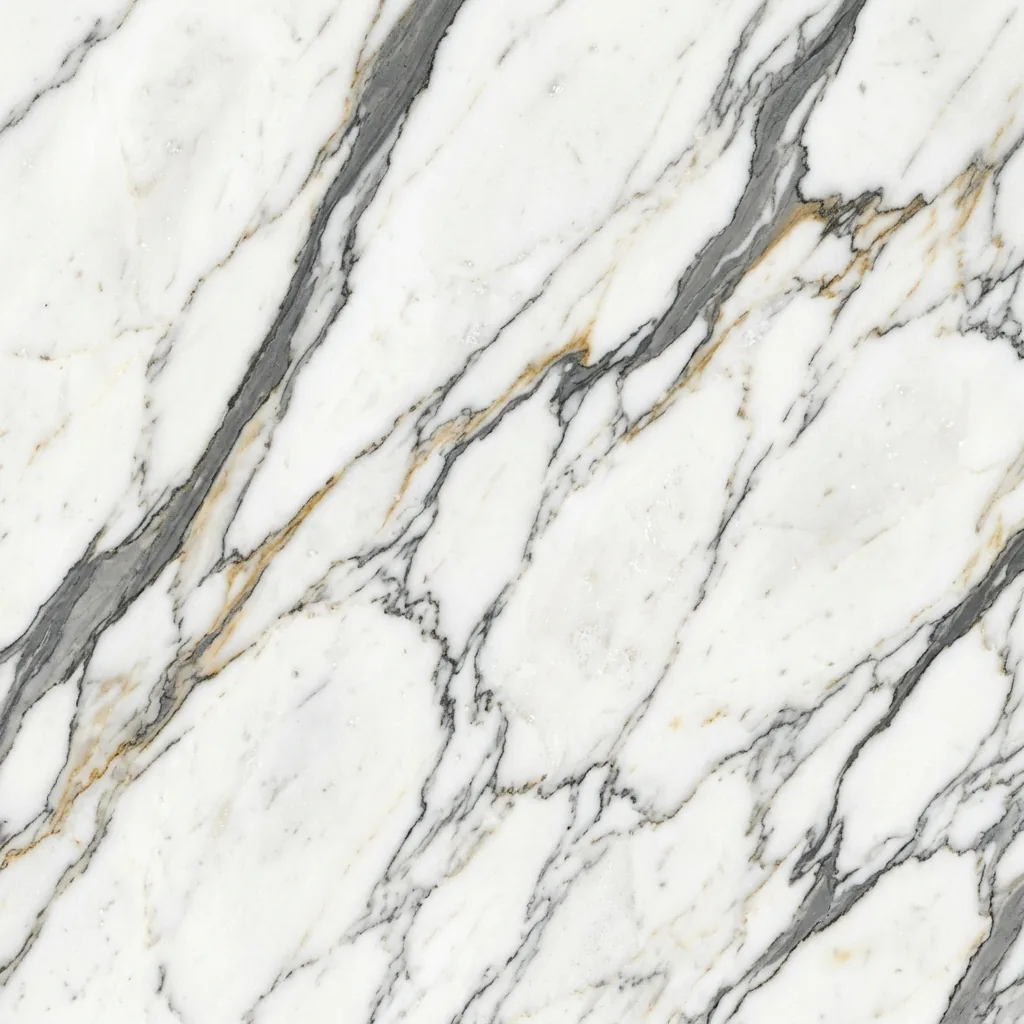
Calacatta is the marble most people picture when they imagine a dream kitchen: a bright white ground crossed by thick grey and gold veins. It is also one of the most expensive surfaces in the house, and every bit as soft and acid-sensitive as cheaper marble.

  • 10-year written warranty
  • Most projects in one day
  • Gloss or Matte/Satin
Calacatta marble with bold grey and gold veining on a bright white ground

Calacatta + Stone Protection Film

  • No etching
  • No stains
  • Everyday scratches resisted
Stone type
Marble (calcite)
Origin
Apuan Alps, Tuscany, Italy
Hardness (Mohs)
About 3
Etch risk
Very high
Stain risk
Moderate
Scratch risk
High

Risk shown for unprotected stone. With our film, all three are covered.

Before you try anything: always speak to a professional before cleaning, treating or applying any product to your stone. Every slab is different, and the wrong product can cause permanent damage. Contact us or a qualified stone restorer first.

Quick answer

Calacatta marble etches from lemon juice, wine, vinegar and many spray cleaners, and sealing does not stop it. The way to keep a Calacatta benchtop or island looking like the day it was installed is a clear anti-etch film: Gloss for polished Calacatta, Matte/Satin for honed. It also blocks coffee, oil and wine stains.

Key points

  • Calacatta is a true marble, so it etches like any other.
  • The bright white ground makes stains and etches easy to see.
  • Bookmatched and waterfall slabs are nearly impossible to replace.
  • Film goes on without cutting or removing the stone.

What makes Calacatta different

Calacatta (often searched as "Calcutta marble") comes from a small number of quarries high in the Apuan Alps above Carrara. Compared with Carrara it has a whiter, warmer background and far bolder veining, sometimes several centimetres wide, in grey, charcoal and gold. Named variations include Calacatta Oro, Calacatta Gold, Calacatta Borghini and the burgundy-veined Calacatta Viola.

Because good Calacatta blocks are scarce, slabs are priced accordingly and are usually chosen for the most visible surfaces: the kitchen island, a waterfall end, a statement vanity. Those are also the surfaces that see the most wine glasses, lemon wedges and hot coffee cups.

Why Calacatta shows damage more than most

A white stone hides nothing. Coffee rings, turmeric, red wine and cooking oil stand out against the ground, and on a polished slab an etch catches the light as a cloudy patch the moment the sun comes through the window. The dramatic veining that makes Calacatta beautiful also makes repairs harder, because a restorer has to blend any re-polished area into a surface that is anything but uniform.

Our Mosman clients chose Calacatta for their island knowing all of this. After six months of red wine, lemon juice and kids, they told us there was not a single mark. See the project.

Already marked?

Repairing damaged Calacatta marble

Protection works best on a surface that already looks the way you want. If yours is stained or etched, here is what each kind of damage is and how it is usually fixed. Then we protect it so it stays that way.

01

Wine glass rings

Pale, dull circles are etches. A stone restorer can polish them out of polished Calacatta; they should not be scrubbed or sanded at home.

02

Coffee and tea marks

Brown rings are usually tannin stains, often with a light etch inside. A hydrogen peroxide poultice lifts the colour; any etch is then polished.

03

Oil darkening near the cooktop

Oil shows as a darker, translucent patch. An absorbent poultice with a solvent draws it out over one to two days.

04

After it is restored

Film straight after restoration locks in the finish so you only pay for the repair once.

Choosing a finish

Gloss or Matte/Satin on Calacatta?

Polished Calacatta is usually filmed in Gloss, which deepens the veining and keeps the mirror reflection. Honed Calacatta, increasingly popular in Sydney kitchens, is filmed in Matte/Satin to keep its soft, powdery look. Both give the same protection.

Calacatta questions

Frequently asked

Yes. Calacatta is made of calcite like every true marble, so lemon juice, wine, vinegar, tomato and acidic cleaners will etch it within minutes, sealed or not.
"Calcutta" is a common misspelling of Calacatta. They are the same stone, quarried in the Apuan Alps in Tuscany.
Yes. We film the top and the waterfall ends, with edges finished so the join is not visible in normal light.
No. The film is optically clear and non-yellowing. It will not warm or grey the white background.

Protect your Calacatta marble for the next decade.

Request a free quote online or by email. We will call to arrange an on-site visit or a quote over the phone.